
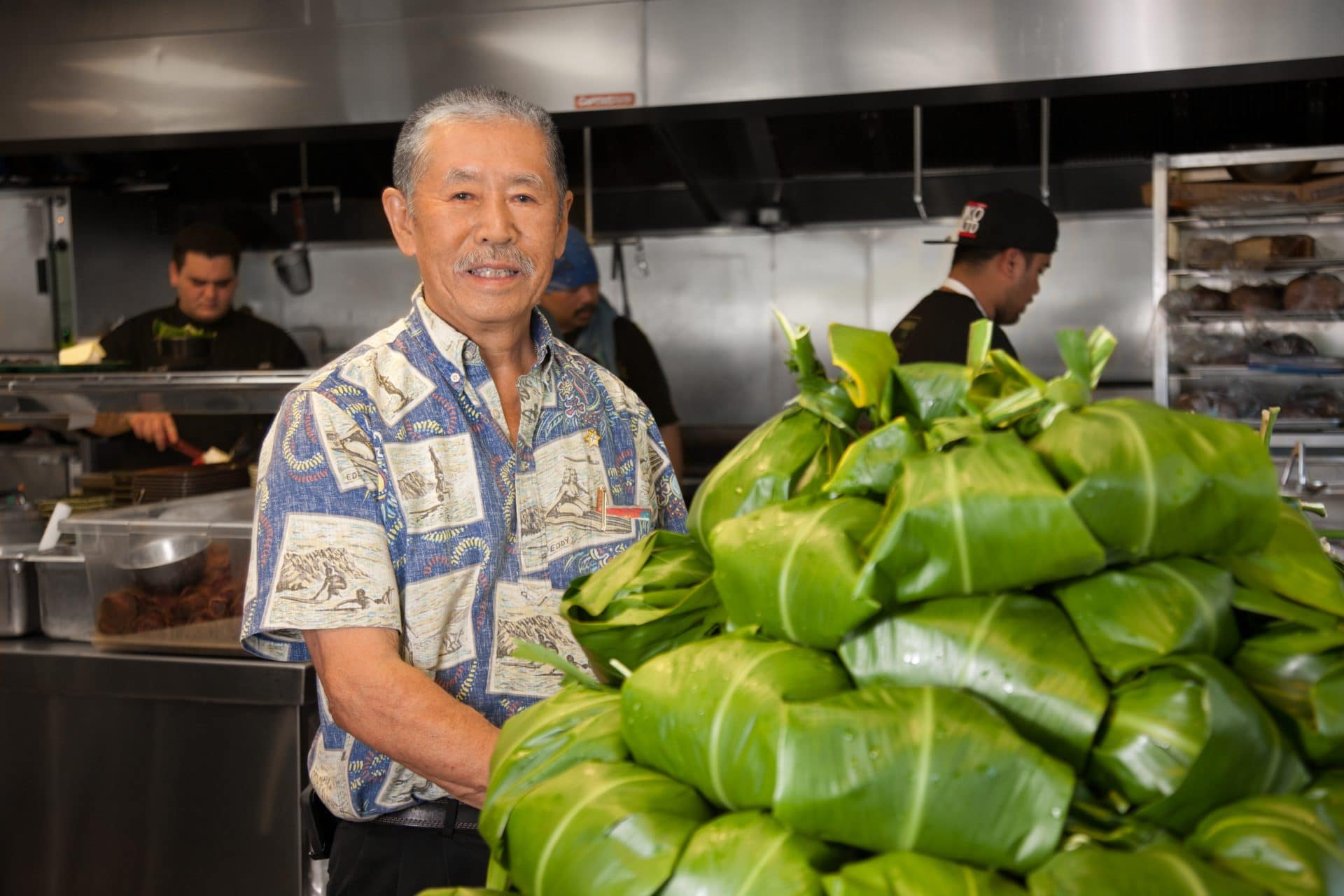
Lau lau cannot be rushed. That's the first thing you learn. You steam it for hours — three, four, sometimes five — and if you open the pot too early, you ruin it. The patience is part of the recipe.
For anyone who hasn't had it: lau lau is a Hawaiian dish where salted pork — and often fish — is wrapped in taro leaves, then wrapped again in ti leaves, then steamed low and slow until the pork becomes impossibly tender and the taro leaves turn dark, silky and subtly earthy. The ti leaves are just the wrapper, not for eating. But the lū'au leaves — the taro — those are everything.
The first time I made lau lau myself, I was in my early twenties, living away from Hawaii for the first time. I was homesick in a deep way, the kind that food can sometimes fix. I called my cousin, who talked me through it for an hour. I made the parcels too big. I used the wrong cut of pork. I steamed them for too long and the ti leaves started to fall apart. They tasted incredible anyway.

The Ritual of Wrapping
Something happens when you wrap lau lau. Your hands find a rhythm. You lay the taro leaf, place the seasoned pork, fold the edges over, then wrap the whole thing in ti leaf and fold it shut. Over and over. It's meditative in the same way that kneading bread is meditative — repetitive enough to let your mind settle, tactile enough to keep you present.
In Hawaii, lau lau is often made in large quantities for family gatherings. Everyone sits together and wraps. Stories get told. The children run around underfoot. By the time the parcels go in the steamer, you've spent hours together already. The food is almost secondary to the making of it.
I carry that ritual into my cooking philosophy. The process isn't just a means to an end. It is the thing. The time you spend making food is time you're giving to the people who will eat it.

What Slow Cooking Teaches You
There are faster dishes. Of course there are. But the slow ones teach you something the fast ones can't. They teach you to trust the process when you can't see results. They teach you to read signals — the sound of steam, the smell shifting from raw to cooked to caramelised — rather than relying on timers and certainty.
Lau lau taught me to cook by feel. And cooking by feel, I've found, is where the real food lives. Not in the recipe, but in the space between the instructions. In the moments when you taste and adjust, taste and adjust, until something clicks into place and you know — you just know — it's done.
That's what I want every dish at Aloha House to carry. That sense of someone paying attention. Someone who waited as long as it needed.